Mills Violano Restoration
When a Mills Violano comes into my shop for restoration, I normally begin by getting the instrument operating before taking it apart. Even an instrument that has been sitting for many years or is in very poor condition can tell me a great deal once I can get its basic systems functioning.
Over the years, many Violanos have been repaired, rewired, altered, or adjusted by different people. Parts may have been replaced, incorrect materials may have been used, or adjustments may have been changed in an attempt to solve other problems. I want to identify these issues before the instrument is disassembled.
At this stage, I am not trying to make the Violano perform perfectly. Temporary repairs, cleaning, lubrication, or adjustments may be necessary simply to get the various systems operating. This allows me to test the magnets and solenoids, operate the violin and piano mechanisms, check the bowing system and bow wheels, and determine whether the instrument can be brought into proper adjustment.
This is especially important with the violin mechanism. The fingers, bowing system, and related mechanisms have to operate within the proper range of adjustment. Incorrect cushions or felt, altered parts, previous repairs, or improper dimensions can make correct adjustment difficult or sometimes impossible. I want to discover those problems before restoration begins rather than after the instrument has been completely rebuilt.
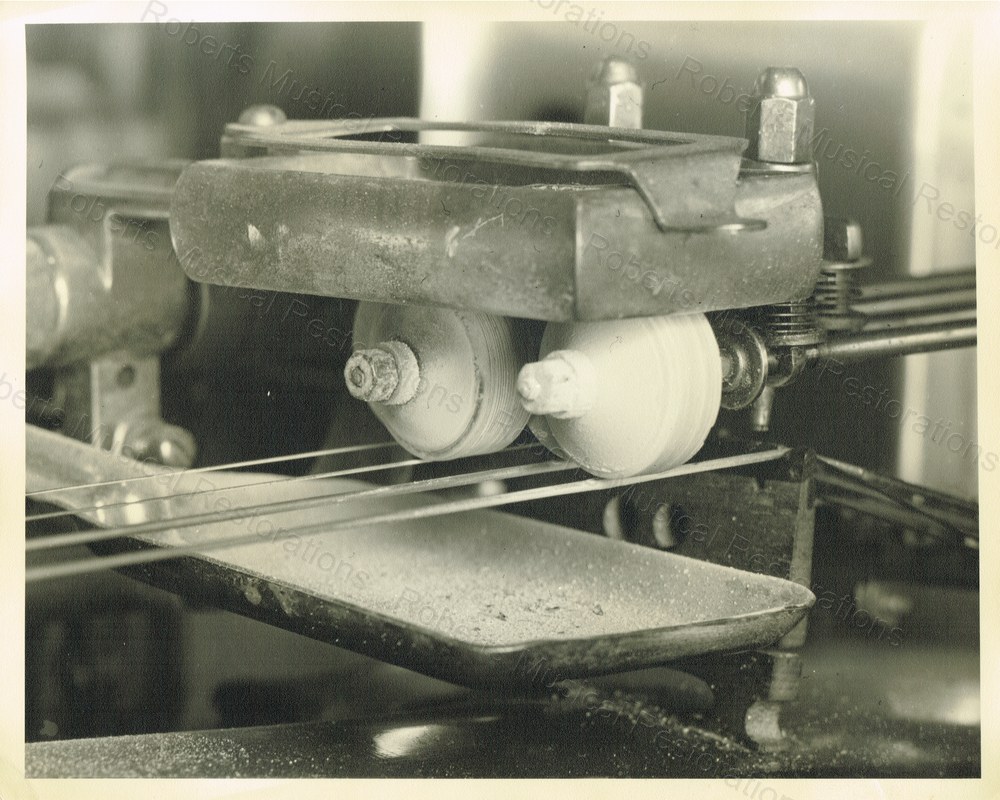
The bow wheels are also carefully inspected. In many restorations the bow wheels need to be replaced, but if the original wheels are in good condition and operating properly, there is no reason to replace them simply for the sake of replacing them. When replacement is necessary, Roberts Musical Restorations is the only manufacturer in the world currently producing reproduction bow wheels specifically for the Mills Violano.
Getting the Violano operating also allows me to identify missing parts, components that can be restored, and anything that is damaged or altered beyond practical repair and needs to be replaced. Roberts Musical Restorations maintains the largest inventory of original used Mills Violano parts in the world, allowing many missing or unusable components to be replaced with original parts.
Once this initial evaluation is complete, I can discuss my findings with the owner and explain what the instrument needs, what can be restored, what may need to be replaced, and whether I have found anything unusual that will affect the restoration. This gives the owner a much clearer understanding of what to expect before the instrument is completely disassembled.
Only then do I begin the full restoration. At that point, I know how the instrument operated when it arrived, what problems were present, what previous work may have affected it, and what will be required to return it to proper playing condition.
Violin Mechanism Restoration
The violin mechanism is the heart of the Mills Violano. The bow wheels, bow pressure, finger assemblies, and regulation all have to work together for the instrument to play properly. If the bow wheels are out of adjustment or the fingers do not line up correctly with the strings, the Violano may operate but still fail to produce the sound and character expected from the instrument.
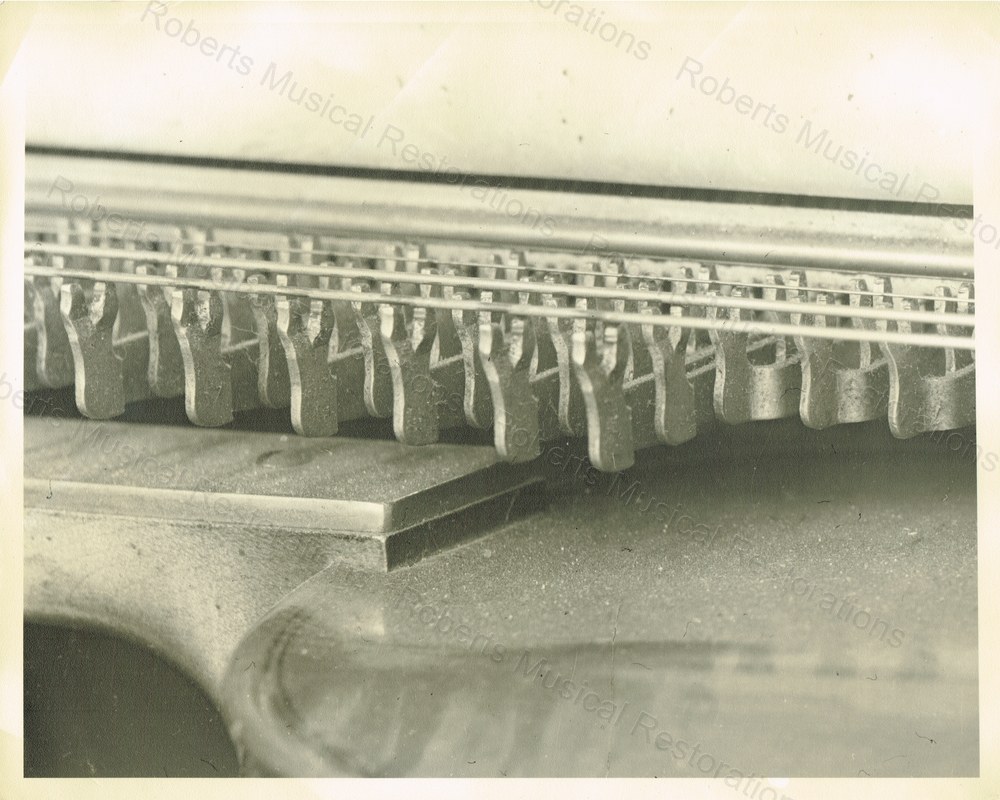
As part of every complete restoration, I completely disassemble the finger assembly rather than simply repairing individual fingers that are sticking, buzzing, or causing a noticeable problem. Each component is cleaned and inspected, the return springs are checked and properly adjusted, and the finger heads are carefully dressed where they contact the violin strings. Over many years of use, the strings wear grooves into these contact surfaces, which can interfere with proper operation and affect the sound of the instrument.
After the finger components have been cleaned and the worn contact surfaces corrected, the parts are glass-beaded and re-nickel plated before the complete assembly is put back together and regulated. Rebuilding the entire finger mechanism in this manner provides a consistent starting point rather than correcting only the problems that happen to be noticeable when the instrument arrives.
The violin itself is also removed and carefully inspected during restoration. Age, constant string tension, and deterioration of the original hide glue can cause portions of the violin body to begin separating. These separations are not always obvious, but they can cause buzzing, poor tone, and other problems that cannot be corrected by adjusting the playing mechanism. The violin is checked carefully to make sure the body and glued joints are completely sound before it is returned to service.
The bridge and its position are also inspected. Over the life of a Violano, bridges are sometimes moved, replaced, or improperly positioned during previous repairs. Correct bridge placement is important to both the operation of the mechanism and the sound of the violin.
The internal sound post is equally important. In many instruments the sound post has shifted or fallen out completely. Its position has a major effect on the tone of the violin. During restoration, the sound post is properly positioned and adjusted to obtain the best bass response and a clear, balanced sound from the violin.
The tremolo mechanism is one of the most important parts of the Violano's violin system and has a tremendous effect on the musical character of the instrument. Although Mills referred to it as the tremolo mechanism, its movement gives the violin the expressive variation in tone that helps create a more natural, singing quality. A Violano can be mechanically operating very well, but if the tremolo is not operating correctly, the difference in the sound of the violin is immediately noticeable.
Proper adjustment of the tremolo mechanism is extremely important. It must operate freely, remain properly aligned, and run at the correct speed. A tremolo that is too fast, too slow, or inconsistent will sound unnatural. When it is properly restored and adjusted, it gives the violin much of the expression and character associated with a properly playing Mills Violano.
Mills used and experimented with different tremolo arrangements during production. On some instruments, a designated contact in the music roll was used to switch the tremolo mechanism on and off during a selection. While this allowed the tremolo effect to be controlled by the musical arrangement, the mechanical system does not always start and stop quickly enough for this method to operate consistently. Different versions of the mechanism can also respond differently depending upon their design, condition, and adjustment.
For this reason, during restoration I normally set the tremolo mechanism to begin operating when the music starts and remain operating throughout the selection, shutting off when the music stops. This eliminates delays caused by repeatedly starting and stopping the mechanism and provides a consistent tremolo effect throughout the performance.
As part of the restoration, the complete tremolo mechanism is inspected, serviced, lubricated, aligned, and adjusted for proper operation and speed. Getting this mechanism right is an important part of final violin regulation. When properly adjusted along with the bow wheels, bow pressure, finger mechanism, bridge, and sound post, the tremolo helps bring all of these elements together and allows the Violano violin to truly sing.
Electrical Controls & Operating Systems
The electrical system of a Mills Violano controls virtually every function of the instrument. During restoration, the wiring, contacts, magnets, solenoids, switches, coin mechanism, converter, and related electrical components are inspected and tested. Previous electrical repairs and wiring changes are common in these instruments, and alterations made many years ago are not always immediately obvious.
All magnets and solenoids are electrically tested, including checking their resistance to determine whether they are operating within the proper specifications. A magnet can still operate without being completely shorted or burned out and yet no longer produce enough force to properly perform the job it was designed to do. For that reason, simply seeing that a magnet operates is not enough.
This is especially important with the violin finger magnets. These magnets must operate at full strength and provide consistent pulling force across the entire finger assembly. A weak magnet may still pull a finger in, but it may not provide enough pressure against the string or respond quickly enough during faster passages. The result can be weak or missed notes, inconsistent response, or the squawking sound sometimes heard when a finger does not make solid contact with the string.
For the Violano to produce a strong, clear tone and for the violin to truly sing, the finger magnets need to respond quickly and consistently throughout the entire mechanism. Their resistance is checked to make sure they are operating within the proper parameters, and any magnet that does not meet those specifications is repaired or rewound to its original specifications.
The contacts throughout the instrument are cleaned, inspected, and adjusted as necessary. The original wiring and wire looms are also carefully inspected. Whenever possible, I prefer to retain the original Mills wiring rather than replace it unnecessarily. Much of the original wiring is extremely well made and, when the insulation remains sound and free from cracking or deterioration, there is no reason to remove it simply because of its age.
In some instruments, the wiring itself remains in excellent condition while the original cotton covering around the wire looms has deteriorated. In those cases, the loom covering can be renewed while retaining the original wiring underneath. If the insulation has become brittle, cracked, or deteriorated to the point that it could cause electrical shorts or reliability problems, the affected wiring is replaced.
The original coin mechanism is also inspected and restored as part of the electrical and operating system. It is tested to make sure it properly registers each coin, accumulates additional plays when multiple coins are inserted, and operates the instrument correctly.
An important part of the original coin mechanism is its carbon contact assembly. The carbon contact blocks are inspected for burning, corrosion, wear, and proper contact. When necessary, these components are restored or replaced so the original coin-operated system continues to function reliably.
The power converter is another important part of the electrical restoration. The original Mills converter changes the incoming one hundred fifteen volt AC power to approximately one hundred fifteen volts DC required by the instrument. The original converter can be restored and retained in operation when an owner wants the Violano to operate as originally designed. However, these original converters can become noisy and less reliable with age.
For that reason, many Violanos have had homemade or aftermarket solid-state converters installed over the years, while the original converter was left in the cabinet for authenticity. When I encounter one of these installations, I inspect and test the existing converter to determine whether it is operating properly and supplying the correct power to the instrument.
If an existing replacement converter performs properly, there is no reason to replace it. If it does not, Roberts Musical Restorations manufactures a compact, self-contained solid-state converter specifically for the Mills Violano. It provides quiet, reliable DC power while allowing the original converter to remain with the instrument.
The owner's preference is also important. Some owners want the original Mills converter restored and operating as it did originally, and that can certainly be done. When a modern MIDI system is being installed, however, a solid-state converter is required because the original converter is not suitable for reliable operation with modern MIDI electronics.
Once the electrical restoration is completed, the entire system is tested while the Violano is actually playing. This verifies that the electrical controls, magnets, solenoids, coin mechanism, converter, and mechanical components are all working together correctly under normal playing conditions.
Roll Frame & Music Roll Systems
The roll frame is inspected and adjusted to make sure the music roll tracks properly and that the contact wires align correctly with the perforations in the roll. Before making adjustments to the roll frame, however, it is important to determine whether a tracking problem is actually being caused by the mechanism or by the music roll itself.
Many original and older reproduction rolls have changed with age. Depending on the paper and the manufacturer, the paper can shrink or distort enough that the roll will no longer track correctly. This is particularly common with older rolls that have been stored for many years. No amount of adjustment to the roll frame can completely correct a roll that is dimensionally incorrect, so the roll itself must first be eliminated as the source of the problem.
Once a proper roll is being used, the roll frame can be adjusted so the paper tracks correctly and the contact wires pass evenly through the perforations. The contact wires are individually inspected for wear, burning, damage, and proper alignment. They are then adjusted so they contact the contact bar evenly and consistently. Damaged or badly burned contact wires are replaced as necessary.
The contact bar itself is also carefully inspected. The original Mills system relies on electrical contact between the wires and the bar, and after many years of operation the contact surface can become worn or pitted from electrical arcing. Poor contact at this point can result in missed notes, inconsistent operation, or notes that do not respond cleanly. The contact surface must therefore be in good condition and properly aligned with the contact wires.
The governor is another critical part of the roll-frame mechanism. It is a delicate assembly and is frequently found damaged, improperly adjusted, or binding from years of wear or previous repairs. The governor must move freely and operate correctly in order to maintain the proper music-roll speed. A governor that is binding or malfunctioning can cause the roll to run at the wrong speed and, in some cases, allow it to run excessively fast.
During restoration, the governor mechanism is removed, inspected, cleaned, and properly lubricated. Its ball-bearing guides and related components are checked to make sure the assembly moves freely without binding. The governor also affects the proper friction and operation of the contact-bar mechanism, making its condition and adjustment an important part of reliable roll-frame operation.
The rewind and play mechanism is also inspected and tested. The rewind sizer detects when the music roll has reached the proper point at the end of play and initiates the rewind cycle. This mechanism must operate correctly so the roll changes from play to rewind at the proper time and, after rewinding, returns correctly to the play position.
When the rewind mechanism is not operating properly, the paper can continue feeding until it comes completely off the spool, shutting down operation of the instrument. Other problems can cause the mechanism to fail to enter rewind, remain stuck in rewind, or fail to return properly to the play position. Corroded contacts, lack of lubrication, sticking components, and long periods of inactivity are common causes of these problems. The complete rewind and play mechanism is therefore cleaned, inspected, lubricated, adjusted, and tested to make sure the transition between playing and rewinding operates reliably.
If the Violano is equipped with a separate rewind box, it is also inspected, serviced, and tested for proper operation. Not all Violanos use the same rewind arrangement, so the system is restored according to the particular configuration of the instrument.
Once the restoration and adjustments are completed, the roll-frame system is tested with known good music rolls. The final adjustment ensures that the paper tracks properly, the contact wires remain correctly aligned with the perforations, the governor maintains the proper playing speed, and the complete play and rewind cycle operates reliably from beginning to end.
Piano Regulation, Tuning & Musical Adjustments
The piano is an important part of the overall musical performance of a Mills Violano, but regulating a Violano piano requires additional steps beyond those used on a conventional piano. The piano is not being played by a person's fingers. Each note is operated electrically by its own magnet and solenoid mechanism, and the action must be regulated accordingly.
During a complete restoration, the piano action is thoroughly rebuilt. Rather than simply replacing worn hammer felt, I replace the hammer butts, hammer shanks, hammers, bridle straps, and other worn action components as necessary. This provides a properly restored action that can then be accurately regulated to the electrical operating system of the instrument.
The normal principles of piano regulation still apply, including the proper adjustment of each individual note and the relationship between the various parts of the action. The important difference is that final regulation cannot be done simply by operating the notes by hand. Each note must also be tested and regulated while its magnet and solenoid are actually energized, because the force being applied electrically is different from the pressure applied when operating the action manually.
Each piano magnet and solenoid is therefore tested to make sure it has adequate and consistent pulling force. The individual notes are then regulated under electrical operation so the action responds evenly across the keyboard. This is a time-consuming process, but it is necessary to achieve consistent response and a properly balanced piano.
The damper system also differs from that of a conventional piano because it is electrically operated. Mills used a number of different arrangements over the years for operating the dampers, sustain mechanism, and soft hammer rail. These systems do not all operate or adjust in exactly the same manner, and proper restoration requires an understanding of the particular mechanism used in each instrument.
Some of these designs perform better than others. When an instrument has an earlier or less effective arrangement, I may discuss with the owner the possibility of installing a later improved Mills mechanism when the proper original components are available. Otherwise, the existing system is restored and regulated according to its original design.
After the piano action and operating mechanisms have been completely regulated, the piano is tuned and the instrument is played under normal operating conditions. Final musical adjustment is then made with the piano and violin playing together, with particular attention given to their balance so that neither overpowers the other and the complete Violano produces a clear, balanced, and musical performance.
Cabinet Restoration
The cabinet of a Mills Violano is completely disassembled as part of a full restoration. These cabinets were constructed in sections and come apart much like a puzzle, allowing the individual pieces to be properly repaired and refinished rather than simply working around the assembled instrument.
After more than a century, deterioration of the original hide glue is common, along with loose or damaged veneer, separation of joints, worn edges, missing pieces, and damage around the top and bottom of the cabinet. Each section is inspected, stripped, repaired as necessary, sanded, and prepared for refinishing. Loose or missing veneer is repaired or replaced, damaged cabinet components are restored, and structural problems are corrected before the finish work begins.
Special attention is given to quarter-sawn oak cabinets. The staining and finishing process is done to bring out the distinctive grain and figure of the quarter-sawn oak rather than covering or diminishing it. Once the woodwork has been properly prepared, the cabinet is stained, lacquered, and finished to bring back the appearance and character of the original instrument.
The glass is removed so the window frames and surrounding cabinet areas can be properly restored and refinished. Brass hardware is cleaned and polished, then protected with lacquer to retain its appearance. Hardware that was originally nickel plated is stripped and re-nickel plated as necessary to restore its original finish. The same attention is given to visible nickel-plated components within the violin compartment, helping restore the bright mechanical appearance that was an important part of the Violano's original novelty and presentation.
The cabinet casters are also disassembled, rebuilt, and lubricated so the instrument can be moved properly. Locks are cleaned, repaired, and tested, and each lock is made functional. The keys are also checked, and when original keys are missing, replacement keys are fitted or made so that all of the cabinet locks operate correctly.
Once the woodwork, glass, hardware, locks, casters, and decorative components have been restored, the cabinet is carefully reassembled. The goal is not simply to make the cabinet look new, but to return the complete instrument as closely as practical to the appearance, finish, and presentation it would have had when originally produced by Mills.
Evaluation & Service
Roberts Musical Restorations also provides evaluations of Mills Violanos for owners who want to better understand the condition of their instrument or determine what would be involved in a complete restoration.
On-site service is also available in certain situations, particularly when I am already traveling in an owner's area. Many operating problems can be diagnosed and corrected during a service visit, and in many cases I can substantially improve the operation and musical performance of an instrument while on site.
However, servicing a Violano in the field has limitations. These instruments contain many specialized components, and it is impossible to carry every part that might be needed when traveling to a service call. A problem may require a particular magnet, solenoid, mechanical component, or other part that could not have been anticipated before inspecting the instrument.
For that reason, an owner considering an on-site service visit should understand that a service call cannot guarantee that every problem will be corrected during that visit. In some cases, additional work may be necessary, and an instrument requiring extensive repairs may ultimately be better suited for restoration at Roberts Musical Restorations.
I think that's enough. I would completely eliminate the “staged repair,” “good candidate for restoration, repair, sales or further inspection,” and all that other stuff. It sounds like generic website copy rather than the way your business actually operates.
And I wouldn't emphasize that traveling is expensive or that you need to be compensated for your time. That's true, obviously, but it doesn't need to be spelled out on the restoration page. The paragraph about the limitations of field service gets the important point across without sounding defensive about the cost.